Brick, Mortar, and a Little Magic: How Small-Town Shops Are Stealing Customers Back from Amazon
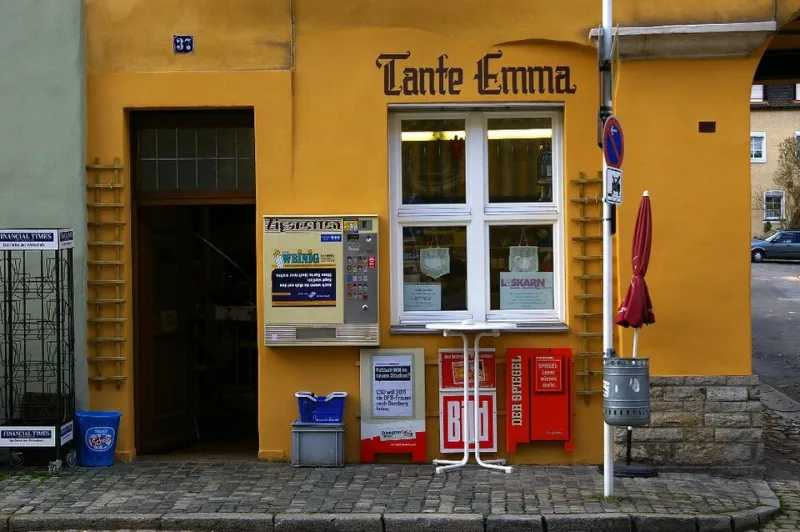
Photo: Galimatiasgg, CC0, via Wikimedia Commons
For a while there, it really did feel like the end. Empty storefronts lined once-bustling downtowns. "For Lease" signs outnumbered open businesses in some blocks. And everybody — the landlords, the chamber of commerce folks, the old-timers nursing coffee at the diner — seemed to agree that Amazon had won.
Turns out, the eulogy was a little premature.
Across the United States, small-town merchants are doing something quietly remarkable. They're not just surviving in the shadow of e-commerce giants and big-box retailers — they're actually growing. Foot traffic is up. Revenues are climbing. And the shoppers who once clicked "add to cart" from their couches are, in surprising numbers, coming back downtown.
So what changed? The short answer is that smart independent retailers stopped trying to out-Amazon Amazon. Instead, they leaned into the one thing a website can never replicate: the feeling of belonging somewhere.
The Experience Economy Hits Main Street
In Fredericksburg, Texas — a Hill Country town better known for peach orchards and wine trails than retail innovation — a kitchen supply shop called The Copper Ladle has become something of a local legend. Owner Maria Sandoval started hosting Saturday morning cooking classes three years ago, mostly on a whim. "I just thought it would be fun," she admits. "I didn't expect it to change everything."
It did. Classes sell out weeks in advance. Participants spend an average of $65 on merchandise after each session — spatulas, Dutch ovens, specialty spices they just learned to use. More importantly, they come back. Sandoval estimates that roughly 70 percent of class attendees become repeat customers within 90 days.
"You can't take a cooking class on Amazon," she says with a shrug. "You can't laugh with your neighbor over a botched hollandaise and then buy the whisk that saved the day — at least not in the same afternoon."
This kind of experiential retail is showing up in towns of every size. A bookshop in Traverse City, Michigan, hosts author nights that double as community gatherings. A feed-and-farm supply store in rural Georgia added a seed library and monthly gardening workshops. A toy store in Bozeman, Montana, runs a weekly "unplugged play hour" for kids and parents that has become, according to the owner, "the most effective marketing we've ever done, and we don't even think of it as marketing."
Hyper-Local Marketing That Actually Works
Beyond events, the merchants who are winning have gotten serious about hyper-local marketing — and they're doing it in surprisingly low-tech ways.
Take Darnell's Hardware in Keokuk, Iowa. Third-generation owner Pete Darnell launched a simple text-message list two years ago. Customers opt in when they check out. He sends one message a week — sometimes a sale, sometimes a tip about winterizing pipes, sometimes just a heads-up that the tulip bulbs arrived. Open rates hover around 80 percent. "My email list was a graveyard," Pete laughs. "Texting is where people actually live."
Social media, used with genuine personality rather than corporate polish, has also become a meaningful driver. Shops that post real, unfiltered content — the owner's dog sleeping in the stockroom, the handwritten thank-you notes they include in every bag, the story behind a new vendor — consistently outperform those trying to mimic the aesthetic of national brands. Authenticity, it turns out, is a competitive advantage that Walmart can't buy.
Many merchants have also doubled down on loyalty programs, but with a community twist. Instead of generic points systems, some shops are tying rewards to local experiences — a free ticket to the town's summer festival, a discount at a neighboring restaurant, a donation in the customer's name to the local food pantry. These programs build emotional investment in a way that a 5% cashback offer simply doesn't.
The Ripple Effect Nobody's Counting
Here's the part of this story that doesn't always make the headlines: when a Main Street business thrives, the whole neighborhood feels it.
Researchers at the American Independent Business Alliance have documented what they call the "local multiplier effect" — the idea that money spent at locally owned businesses recirculates in the community at a significantly higher rate than dollars spent at chains or online retailers. Some estimates suggest that for every $100 spent at a local independent, as much as $68 stays in the local economy, compared to roughly $43 at a chain store and far less when the purchase is made online.
That means the yoga studio that opened next to the revived bookshop. The lunch crowd that fills the sandwich counter because shoppers are downtown anyway. The property values that stabilize when storefronts fill back up. The tax base that funds school programs and road repairs.
In Galesburg, Illinois — a Rust Belt town that lost major manufacturing jobs over the past two decades — a coordinated effort by local business owners to host monthly "First Friday" events has contributed to a measurable uptick in downtown sales and, according to city records, a reduction in vacant commercial properties over the past three years.
"We stopped waiting for a big company to save us," says Renee Hollis, who runs a women's clothing boutique on Galesburg's Seminary Street and helped organize the effort. "We decided to save each other."
What the Data Says
National numbers back up what these individual stories suggest. According to the Institute for Local Self-Reliance, communities with strong independent business sectors have lower unemployment rates and higher per-capita income growth than those dominated by chains. A 2023 survey by the National Federation of Independent Business found that over 60 percent of small retailers reported increased foot traffic when they added community programming or events to their business model.
And while e-commerce continues to grow overall, its share of total retail spending has plateaued in recent years, hovering around 15 to 16 percent of all US retail sales. The physical store, reports of its death notwithstanding, still accounts for the vast majority of how Americans actually shop.
The Secret Ingredient
Ask any of these merchants what really makes the difference, and they'll eventually circle back to the same thing: relationships.
"I know my customers' kids' names," says Maria Sandoval back in Fredericksburg. "I know who just retired and who's going through a hard time and who wants to learn to make tamales because their grandmother just passed and they want to keep her recipe alive. Amazon doesn't know any of that. Amazon doesn't care."
That's not sentimentality. That's strategy.
Main Street was never really competing on price or convenience — and the shops that tried to win on those terms lost badly. The ones that are thriving right now compete on something richer and harder to replicate: the sense that when you walk through that door, you're not just a transaction. You're part of something.
Turns out, that's worth leaving the house for.